
Trust Players to fail
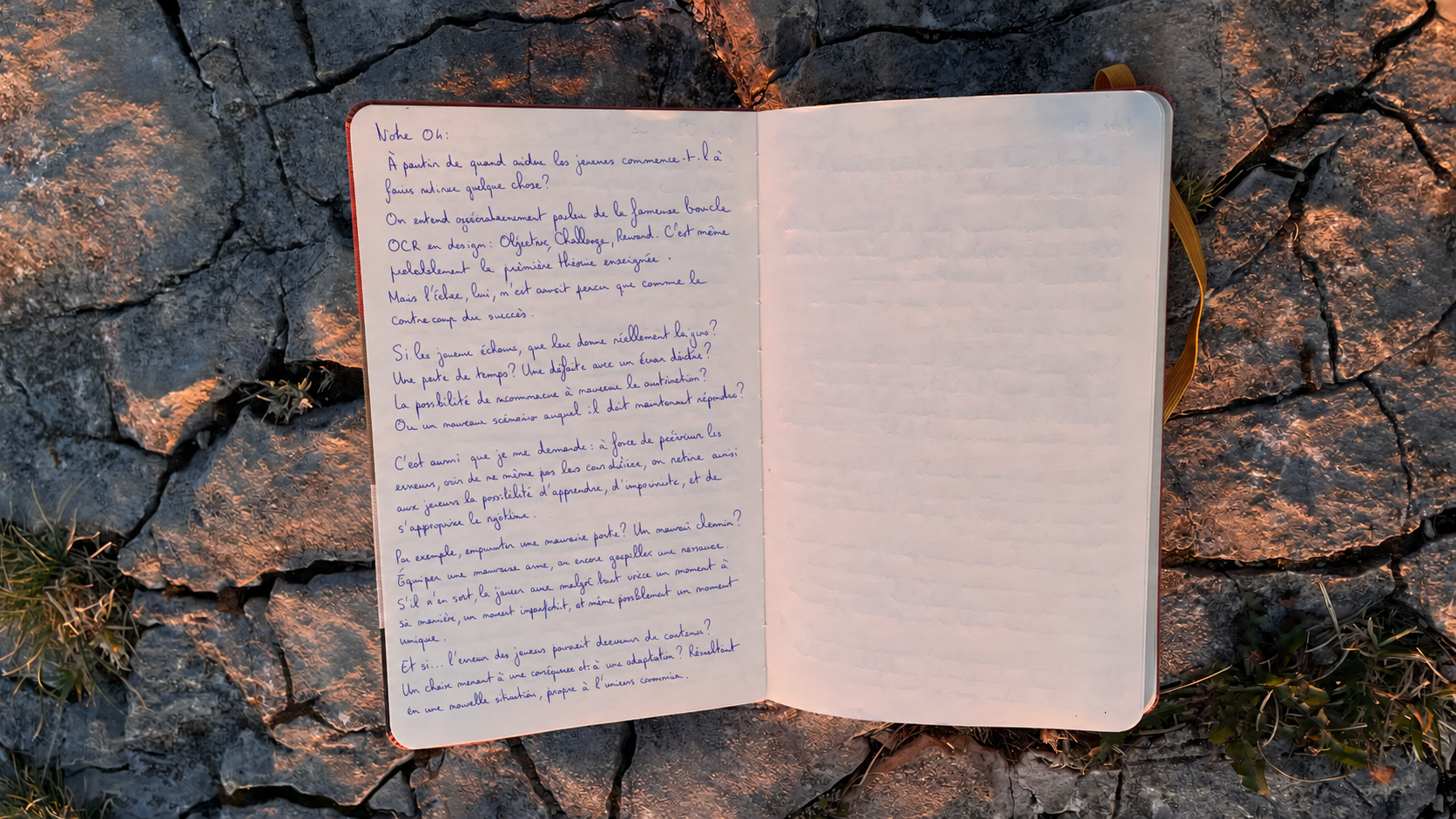
At what point does helping players start taking something away from them?
We hear a lot about the famous “OCR” loop in game design: Objective, Challenge, Reward. It is probably even one of the first theories many of us are taught.
But failure itself is often only perceived as the negative counterpart of success.
If players fail, what does the game actually give them? A loss of time? A dedicated defeat screen? The possibility to simply retry the situation? Or a new scenario they now have to respond to?
That is where I start wondering: by constantly preventing mistakes, or even by barely considering them, are we not taking away from players the possibility to learn, experiment, and truly appropriate the system?
Taking the wrong door, following the wrong path, equipping the wrong weapon, or wasting a resource.
If they still manage to get through it, they will have experienced something in their own way. Something imperfect, and possibly even unique.
And what if... What if players' mistakes could become content?
A choice leading to a consequence, then to adaptation. Resulting in a new situation born from that very mistake.
Of course, some games already do this: Baldur’s Gate 3, Disco Elysium, and many others.
The most obvious examples are often RPGs, because their structures naturally accept that player choices, not only narrative ones, can transform what happens next. Though RPGs are not the only ones: strategy games, simulations, immersive sims, or other systemic games can also preserve a new state after failure and ask the player to deal with it.
A lost character? A failed mission? An alarm triggered? A resource permanently gone?
The game continues, simply from a different state.
Could we try to bring more of this acceptance of failure into our designs, and especially into genres where it is less expected?
That leads me to one last thought: some genres obviously allow this more easily than others, but perhaps the real question is not simply about genre. A game should ask itself whether failure truly needs to interrupt the experience, or whether it can transform it.
This is not always necessary.
Especially when mastery itself is at the core of the experience. In a rhythm game, a precision platformer, or a puzzle game, failure can be part of the very thing the player is trying to overcome. A reset may be exactly the right answer.
I am not saying we should theorize failure at all costs, or design a consequence for every mistake. Because I hate over-theorizing design.
But perhaps accepting that we do not always need to guide players, guarantee their success, or optimize and control every part of their journey is simply a form of trust.
Trusting that players can make mistakes. Trusting that they can adapt. Trusting that they can sometimes create something we never planned for them. And maybe, in the end, talking about mistakes and failure is actually talking about trust.
Perhaps helping players also means knowing when to stop protecting them.